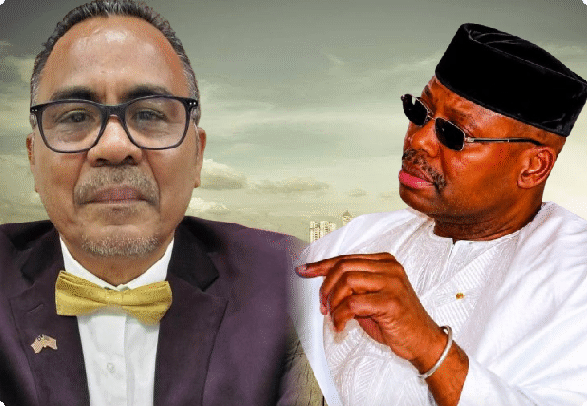
Several people have asked, "Who is Ian Yhap, and what qualifies him to question or respond to Dr. Henry Boima Fahnbulleh?"
That is a perfectly reasonable question.
The answer is that I lay claim to no special privilege, only the perspective of someone who has lived through much of the history being discussed, has known many of the people involved, and believes that our national story deserves to be examined honestly.
For those who have only recently come across my writing because of my exchanges with Dr. Fahnbulleh, let me say this: my interest in Liberia did not begin with this discussion, nor is it confined to it. Over the years, I have written extensively on Liberia, its history, governance, public policy, infrastructure, energy, education, and the everyday experiences that have shaped our people. I have celebrated individuals whose contributions deserve remembrance, criticized policies that I believed were harmful, and offered ideas where I thought they might help. My writing has always been about Liberia first.
Dr. Fahnbulleh simply happens to be one participant in a much larger conversation about our national journey.
I have never regarded myself as a historian in the formal sense. I consider myself an eyewitness, a participant in some events, an observer of many others, and above all, a Liberian who believes that memory carries with it a responsibility. Those of us who witnessed Liberia during its finest years, its most turbulent years, and its gradual decline owe the next generation an honest account of what we saw, what we did, what we failed to do, and what we have since come to understand.
My upbringing exposed me to Liberia in ways that few people experienced. On my mother's maternal side, I was connected to one of the country's most prominent political families. President William R. Tolbert, Jr. was my grand-uncle, and members of that family occupied positions at the highest levels of government. But that was only one half of my story.
On my grandfather's Kru side, my relatives occupied virtually every rung of Liberian society, from fishermen to tax collectors and everything in between. As a young man, I was just as comfortable visiting relatives in the Executive Mansion as I was walking through West Point or New Kru Town to spend time with family there. Those worlds were never separate to me. They were all Liberia. They gave me an appreciation for the hopes, struggles, and perspectives of Liberians from every walk of life.
My education broadened that perspective even further. After kindergarten, I spent sixteen formative years in four very different institutions: Saint Patrick's Elementary School, Ricks Institute, B. W. Harris High School, and the University of Liberia, spending approximately four years in each. Although I did not graduate from every one of those institutions, each considers me one of its own. More importantly, each introduced me to classmates and lifelong friends who would eventually become ministers, military officers, engineers, lawyers, teachers, diplomats, businessmen, activists, politicians, and community leaders. My circle of friendships and acquaintances grew far beyond what most Liberians ordinarily experience. Those relationships have allowed me to observe our country's evolution from many different vantage points.
My professional life added another dimension. I spent decades working in engineering, public utilities, infrastructure, and government, serving Liberia in both the public and private sectors. Those responsibilities brought me into contact with presidents, policymakers, international partners, technicians, laborers, and ordinary citizens whose experiences were often very different, yet equally important.
Today, as an educator, I continue to believe that knowledge carries with it a responsibility to be shared honestly.
None of this makes me infallible. None of it places me above criticism. I welcome correction when I am wrong. Nor is this an attempt to compete with Dr. Fahnbulleh or anyone else over who knows more history. History is not a contest of personalities. It is a search for truth.
My concern is much larger than any individual.
We are gradually losing our understanding of why Liberia became what it is today. A generation is growing up without having lived through the events that shaped our nation. Many of the people who participated in those events have remained silent. Others have spoken, but sometimes in ways that appear selective, incomplete, or inconsistent with the historical record. Whether intentionally or unintentionally, those accounts can leave future generations with an incomplete understanding of how we arrived where we are today.
That is my greatest motivation.
I love Liberia deeply. I believe we are losing a country, and one of the reasons is that we have never fully come to terms with our own history. We cannot solve problems we refuse to understand. We cannot build a better future on foundations of selective memory, convenient omissions, or comfortable myths.
That is why I write.
Not to settle old scores or to diminish anyone's legacy. Not to claim that I possess the final word on any subject. I write because I believe Liberia deserves an honest accounting from all of us who witnessed its promise, its mistakes, and its tragedies. Every voice should be heard, including Dr. Fahnbulleh's. But every voice should also be open to examination.
History belongs to no one individual. It belongs to the Liberian people, especially those who will inherit the country after we are gone.
Silence has already cost Liberia too much. I refuse to let historical silence become another national tragedy.

Towards Economic Empowerment And Reconciliation